Stories and narratives describing interesting observations and research and management findings within the Klamath River Basin.
Published November 2026
Five Organizations Collaborate to Study Cold Water Thermal Refuge Use by Juvenile Chinook Salmon.
Story credit: Summer Burdick (USGS)
As water temperatures rise in the Klamath River, cold water thermal refuges may offer critical habitat for juvenile Chinook salmon on their way to the ocean. But how much these refuges are actually used, and for how long, is still poorly understood.
To answer this question, the Karuk Tribe, Yurok Tribe, U.S. Geological Survey, California Department of Fish and Wildlife, Pacific States Marine Fisheries Commission, and Scott River Watershed Council are collaborating on a coordinated study of refuge use by outmigrating juvenile Chinook salmon. The project depends on shared fish capture, PIT tagging, and detection efforts across all five partners, with data integrated through the KBFC database. Together, the team aims to:
document the timing of refuge use relative to mainstem flow and temperature,
estimate the proportion of tagged juvenile Chinook using these habitats, and
quantify how long fish remain in refuge once they arrive.
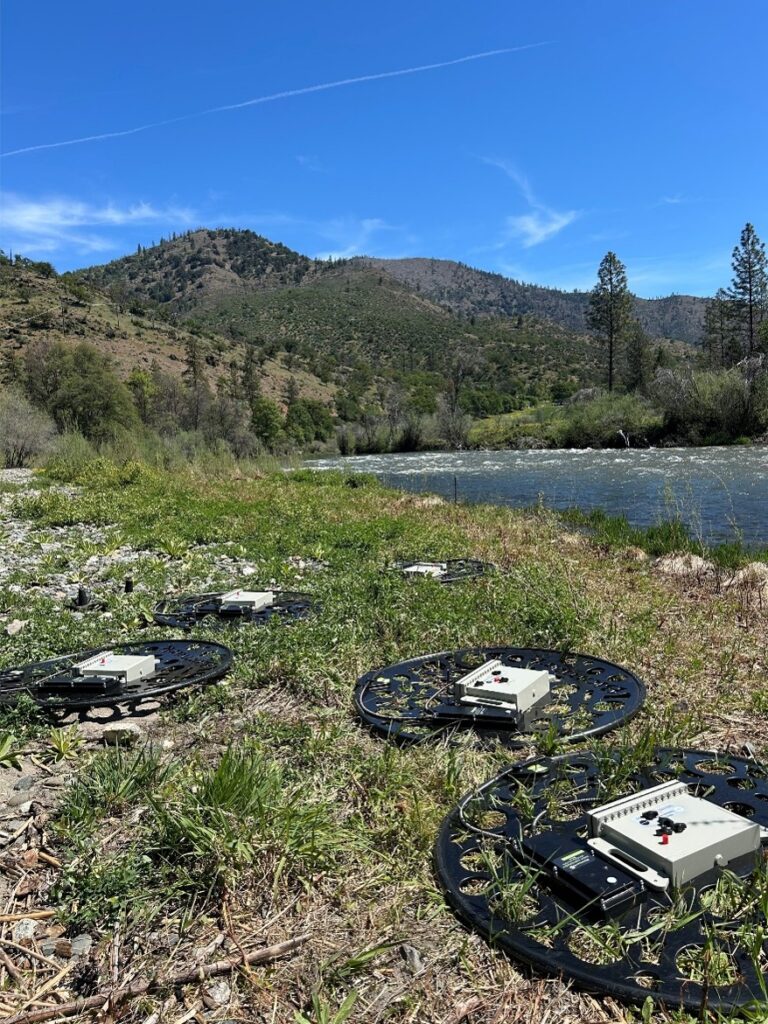
Figure 1. Submersible circular PIT tag antennas prior to deployment in a cold-water thermal refuge at the confluence of Beaver Creek and the Klamath River.
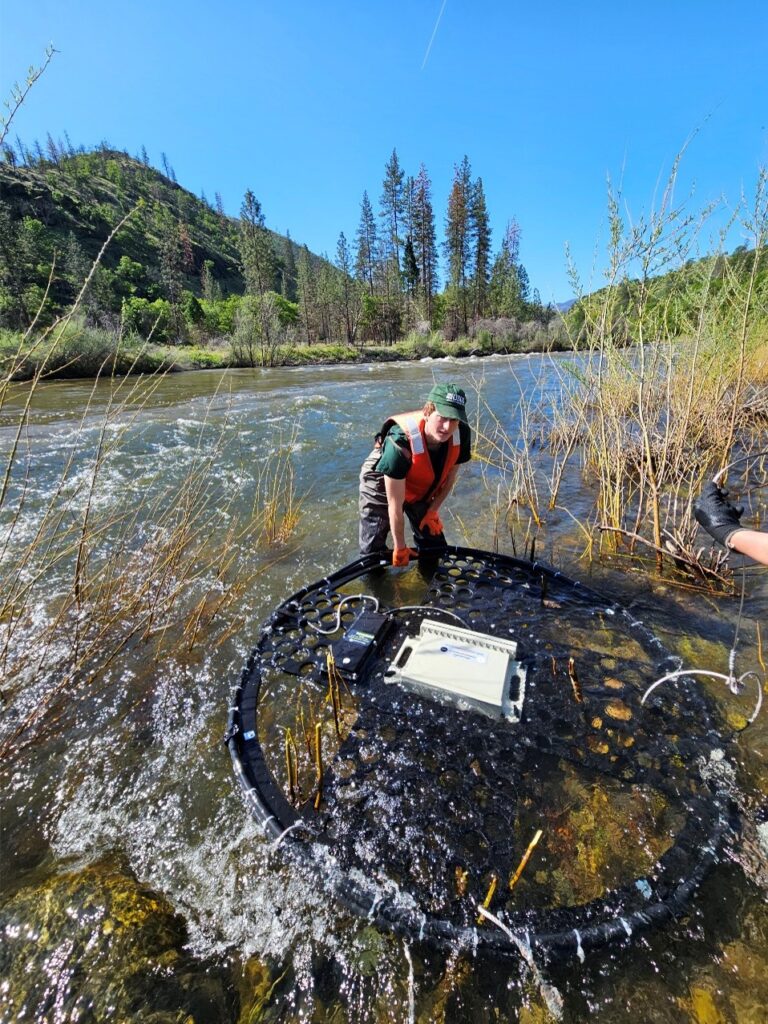
Figure 2. U.S. Geological Survey employee preparing to deploy submersible circular PIT tag antenna into a cold-water thermal refuge at the confluence of Beaver Creek and the Klamath River.
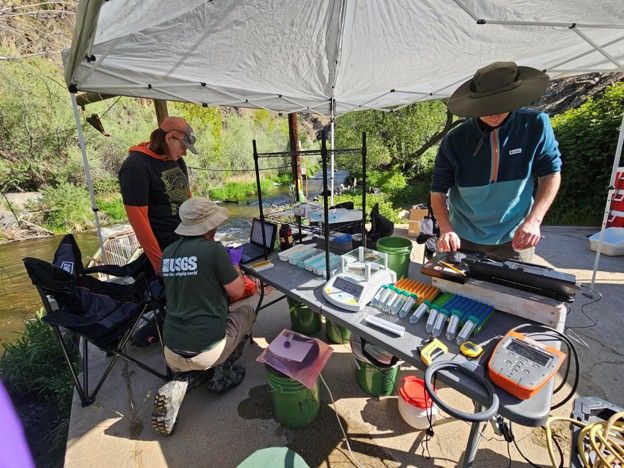
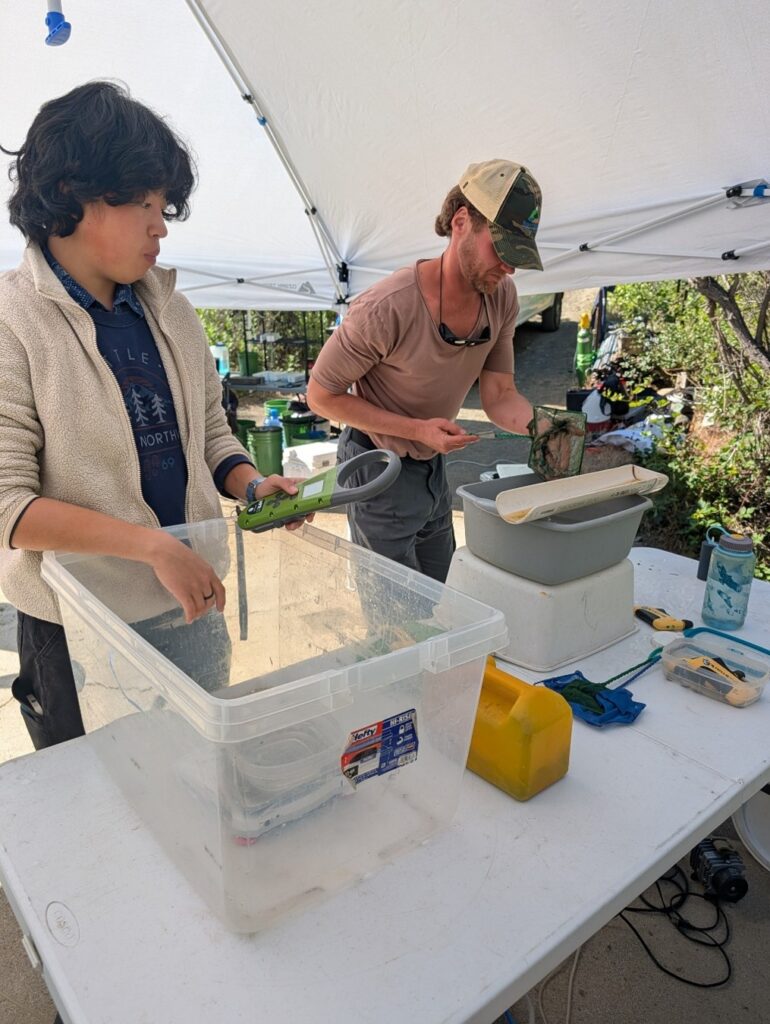
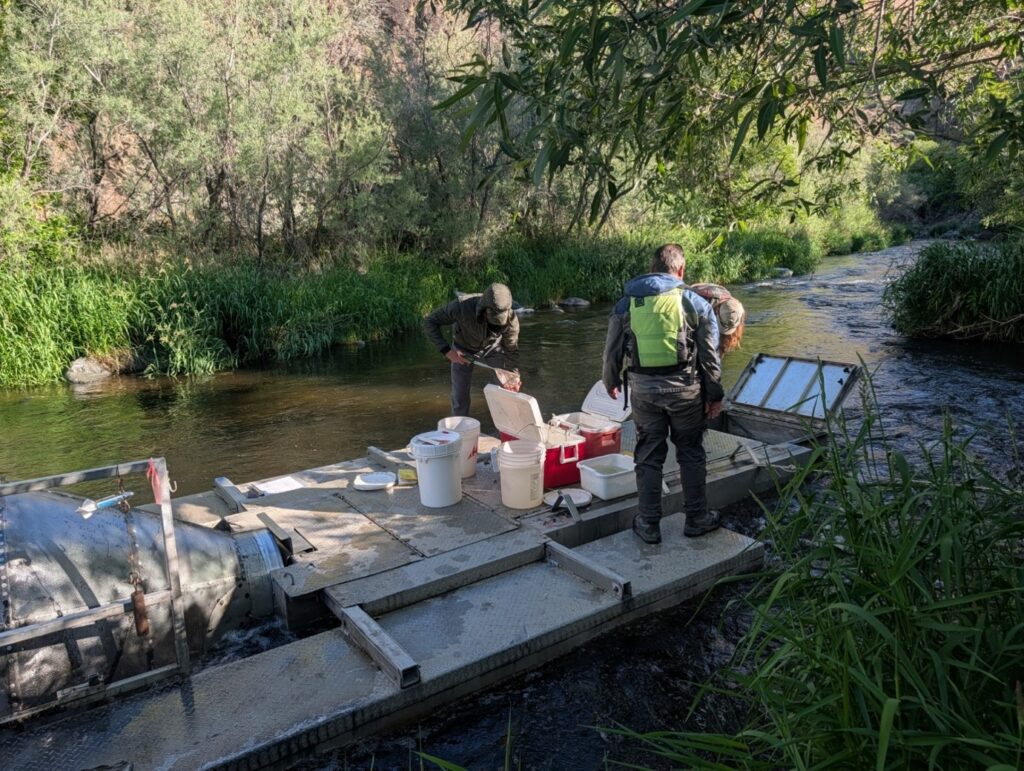
Figure 3. U.S. Geological Survey and Pacific States Marine Fisheries Commission staff prepare to tag juvenile salmon at the Shasta River rotary screw trap in collaboration with California Department of Fish and Wildlife and Scott River Watershed Council.
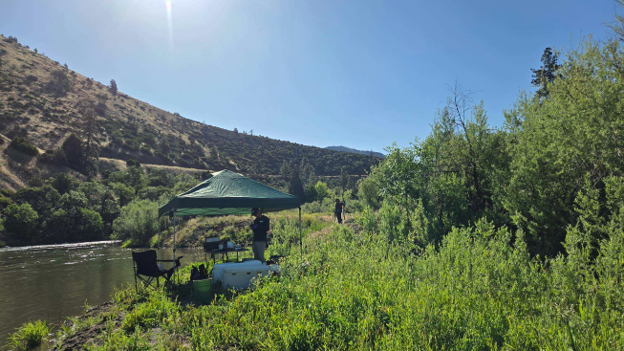
Figure 4. U.S. Geological Survey preparing to capture juvenile fall run chinook salmon for PIT tagging at Tree of Heaven with a beach seine in collaboration with the Karuk Tribe.
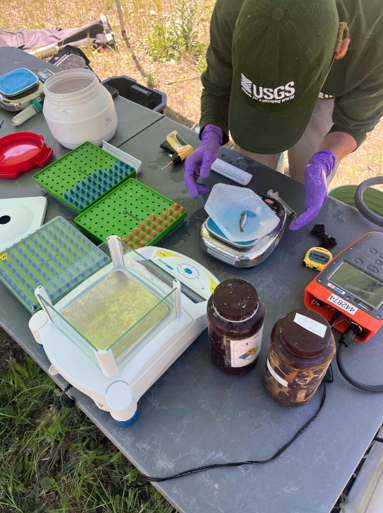
Figure 5. U.S. Geological Survey staff weighing a juvenile fall run chinook salmon during PIT tagging procedure.
Beaver Creek as a focal site.
Using the Beaver Creek cold water thermal refuge as a case study, the team conducts paired releases of PIT tagged and acoustically tagged juvenile Chinook from multiple sites upstream of the refuge. Led by USGS, the analysis draws on two data streams. Acoustic detections along the migration route estimate survival from release to the refuge, while PIT detections from an array of submersible circular antennas within the refuge capture the timing and duration of use.
An innovative Bayesian mark recapture framework ties these two streams together. It combines acoustic survival estimates with PIT detection histories to estimate refuge use, while accounting for the probability that fish reach the refuge at all and for imperfect detection. This approach lets researchers examine how flow, temperature, and other environmental variables shape both the likelihood and the duration of refuge use.
Why it matters.
As dam removal reshapes the Klamath River, this work will help clarify the role cold water refuges play in supporting population resilience and survival for juvenile Chinook salmon during their outmigration.
Image provided by SRWC
Image provided by SRWC
Published March 2024
Juvenile Coho Salmon PIT Tagging by the Scott River Watershed Council (SRWC).
Story credit: Harrison Morrow (SRWC)
For the past eight years, the Scott River Watershed Council (SRWC) has been PIT-tagging juvenile Coho Salmon (Oncorhynchus kisutch) in both treated and untreated stream reaches. These fish have the potential to be detected passing through a network of stationary antennas placed throughout the watershed, or at an in-hand sampling event using a handheld tag reader. The data collected from these tag detections provide insight into how and when Coho Salmon use various rearing habitats and migration pathways.
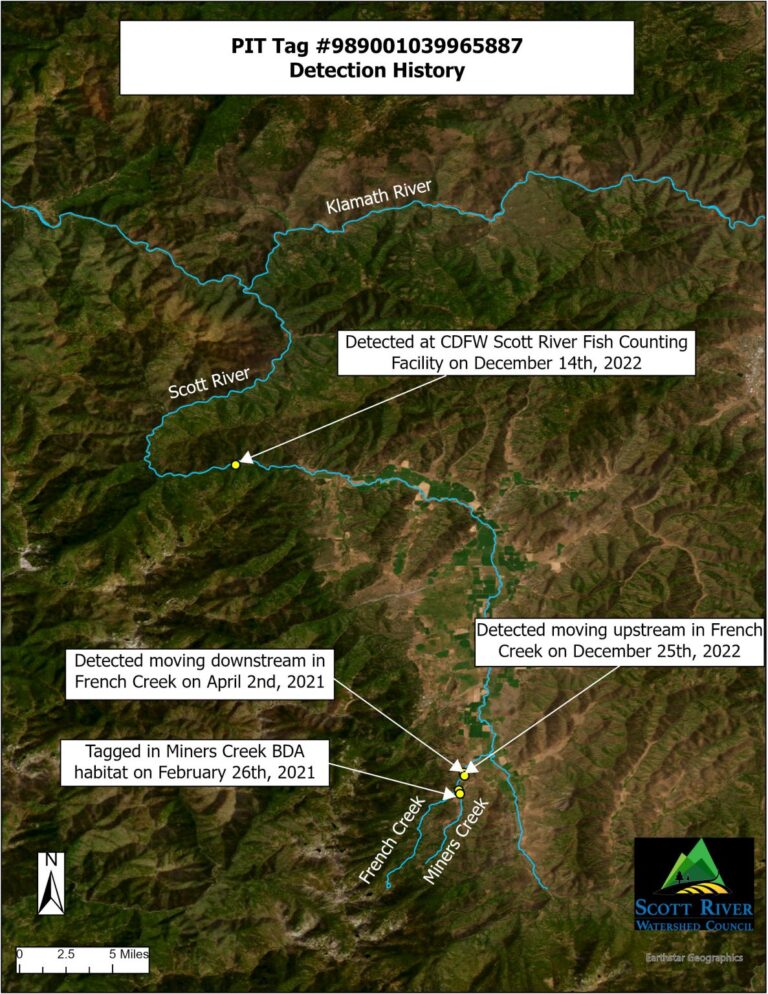
In December of 2022, PIT antennas on the mainstem Scott River and French Creek detected an adult Coho Salmon returning to spawn in French Creek, its natal stream. This fish was tagged in a beaver dam analogue (BDA) habitat in Miners Creek, migrated out to the ocean and was detected 20 months later traveling up the Scott River and French Creek as an adult. To date, the sample size of returning adults tagged by SRWC has been rather small. However, we are hopeful that with continual effort and increased survival we may start to see trends in which types of rearing habitats are more successful in producing outmigrants that return to spawn.